Blog · Training Tips
Towered Airports Near Redlands: Where to Practice With a Control Tower
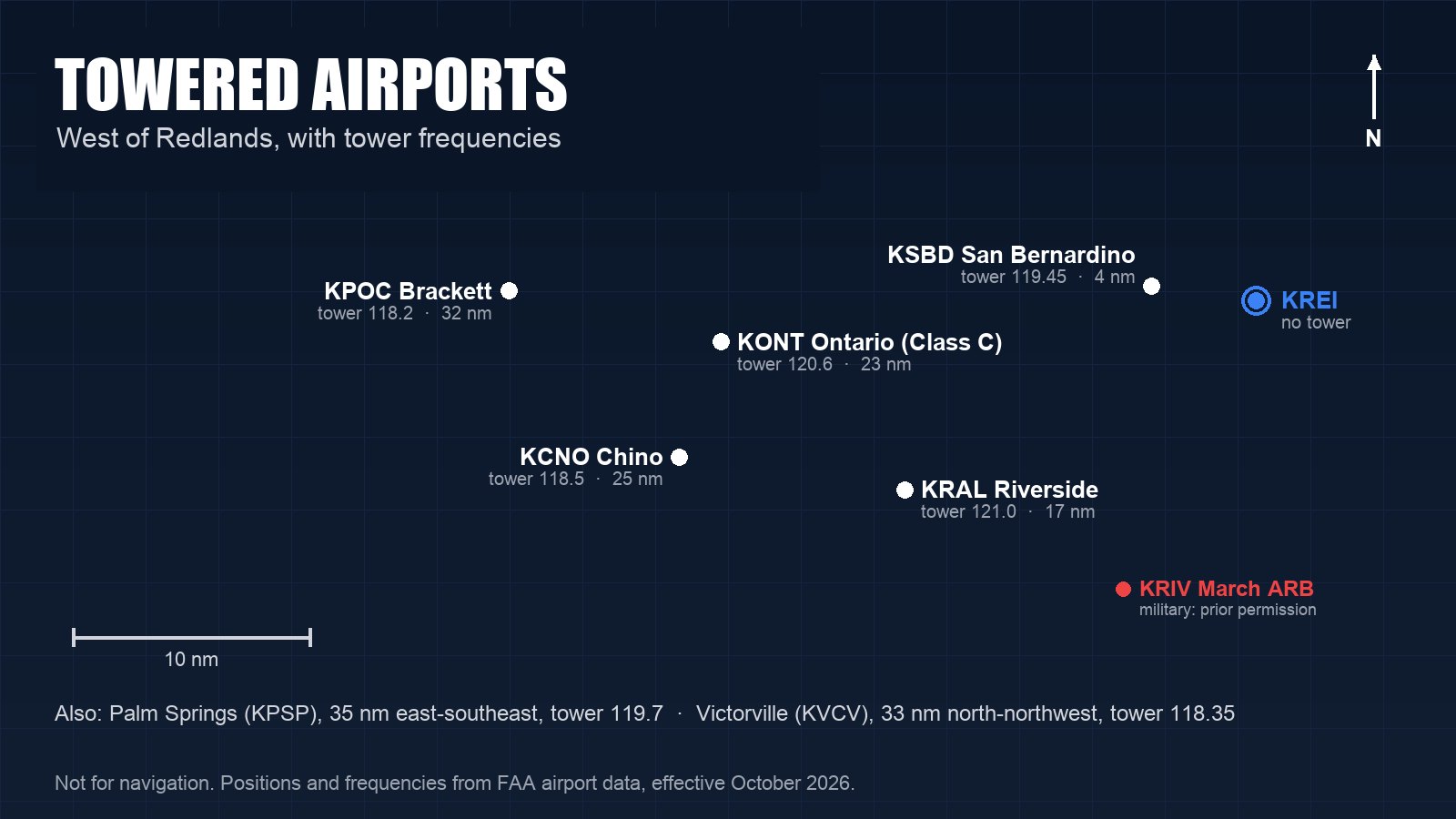
Redlands Municipal (KREI) has no control tower, which is part of what makes it a pleasant place to fly. But every pilot needs to be comfortable talking to a tower, and a private pilot certificate requires three solo takeoffs and landings to a full stop at an airport with an operating control tower (14 CFR 61.109). The good news is that the towered airports near Redlands are close, varied and good for training.
Frequencies and hours below are from the FAA's current airport data. Always check the Chart Supplement before you go.
San Bernardino International (KSBD), 4 nautical miles west
The closest tower is practically next door. San Bernardino has a 10,000-foot runway, 6/24, and regular large-jet traffic, which makes it a good place to learn sequencing, wake turbulence avoidance and how to fit a Cessna in with faster airplanes.
- Tower: 119.45, open 7 a.m. to 9 p.m.
- Ground: 121.8
- Digital ATIS: 124.175
- Class D airspace up to 3,200 feet MSL
From Redlands, you'll be in San Bernardino's airspace within minutes of departing to the west, so it's a natural place to make your first call to a tower.
Riverside (KRAL), 17 nautical miles southwest
Riverside is a busy general aviation airport with a good mix of training traffic, and it's a favorite for practicing tower work without airline traffic.
- Tower: 121.0, open 7 a.m. to 8 p.m.
- Ground: 124.125
- ATIS: 128.8
- Runways: 9/27, 5,401 feet, and 16/34, 2,850 feet
The FAA notes that airplanes departing from one end of Runway 9/27 can't be seen from the other end, and that there are power lines north of the Runway 16 threshold. Riverside also has noise procedures for departures, so read its remarks before you go.
Chino (KCNO), 25 nautical miles west
Chino has three runways, two tower frequencies, and a lot of interesting airplanes: it's home to the Planes of Fame Air Museum and the Yanks Air Museum.
- Tower: 118.5 and 120.125 (the Chart Supplement shows which runways use which), open 7 a.m. to 9 p.m.
- Ground: 121.6
- ATIS: 125.85
- Runways: 8R/26L, 7,000 feet; 8L/26R, 4,858 feet; 3/21, 4,919 feet
Brackett Field (KPOC), 32 nautical miles west
Brackett in La Verne has parallel runways with separate tower frequencies, which makes it good practice in listening carefully.
- Tower: 118.2 for 8R/26L and 133.3 for 8L/26R, open 7 a.m. to 9 p.m.
- Ground: 125.0
- ATIS: 124.4
The FAA warns of rapidly rising terrain a mile west-northwest of the airport.
Ontario International (KONT), 23 nautical miles west
Ontario is Class C airspace around a busy airline and cargo airport. You must establish two-way radio communication with ATC before entering Class C, and your airplane needs an altitude-reporting transponder and ADS-B Out. It's excellent experience for flying through or near busy airspace with flight following. As a training stop it's less practical: the FAA notes that parking and ground services are limited for unscheduled operations, so call the airport first if you plan to land.
Two that need special care
March Air Reserve Base (KRIV), 13 nautical miles south-southwest, is a military field with Class C airspace. Civil touch-and-goes aren't allowed, and transient aircraft need prior permission. Expect to talk to March or SoCal Approach as you pass by, not to land there.
Palm Springs (KPSP), 35 nautical miles east-southeast through the San Gorgonio Pass, is a great towered destination for a longer lesson, with a tower open 6 a.m. to 11 p.m. on 119.7.
What to expect on your first visit
At a towered airport, you need a clearance from ATC to taxi, take off or land (14 CFR 91.129), and you need a specific clearance before you cross or enter any runway. A typical arrival goes like this: you listen to the ATIS, call the tower with your position, altitude and the ATIS letter, and the tower tells you how to enter the pattern, for example "make right traffic, Runway 24, report midfield." Later you'll hear "cleared to land." After you exit the runway, you stop past the hold-short line and switch to ground control for taxi instructions.
On departure it runs the other way: ground control for taxi, then the tower for takeoff clearance when you're ready at the runway. If you're not sure what you were told, ask before you move.
How to sound good on the radio
- Listen first. Get the ATIS before you call, and listen to the frequency for a minute so you don't step on anyone.
- Who, where, what. Say who you're calling, who you are, where you are and what you want, then stop: "Riverside Tower, Cessna 5424 Tango, 10 miles northeast, 3,500, inbound for landing with information Bravo."
- Read back runway assignments, hold-short instructions and altitudes.
- Ask when you're unsure. "Say again" is always better than guessing.
- Know the light gun signals in case your radio fails.
Make it a lesson
A good towered-airport lesson from Redlands might be San Bernardino for a landing, Riverside for a few touch-and-goes, and back to Redlands, all in about an hour. Your instructor can handle the radios the first time and hand them to you the next.
Cornerstone Flight Academy trains student pilots at Redlands Municipal Airport. Call or text (909) 330-4748, or visit flycornerstone.com.
Book a $120 intro flight · Aircraft rental and time building · Pilot training at Cornerstone · More from the blog