Blog · Operations
Renter's Insurance for Pilots: What Non-Owned Aircraft Coverage Does
If you rent airplanes, you need renter's insurance, also called non-owned aircraft insurance. It's one of the least exciting parts of flying and one of the most important, because the airplane's own insurance policy is there to protect the airplane's owner, not you. This post explains what renter's insurance does, what to look for, and what Cornerstone Flight Academy requires.
This is general information, not insurance or legal advice. Read your own policy, and ask your agent about anything that isn't clear.
Why the owner's policy isn't enough
Every rental airplane is insured, but that policy is written for the owner. If you damage the airplane, the owner's insurer may pay to fix it and then try to recover that money from the pilot who was flying, and the owner may still be out its deductible and the income lost while the airplane sits in the shop. Renter's insurance is how you protect yourself from that bill, and from claims by anyone else if something goes wrong.
What a renter's policy covers
Policies vary, but most renter's policies combine a few kinds of coverage:
- Liability for injury to other people and damage to their property, including passengers in many policies
- Damage to the non-owned aircraft, the airplane you're renting, up to a limit
- Medical payments for you and your passengers, in many policies
Pay attention to the limit for damage to the aircraft itself. It's often a separate, smaller number than the liability limit, and it's the part a rental operation cares about most.
What Cornerstone requires
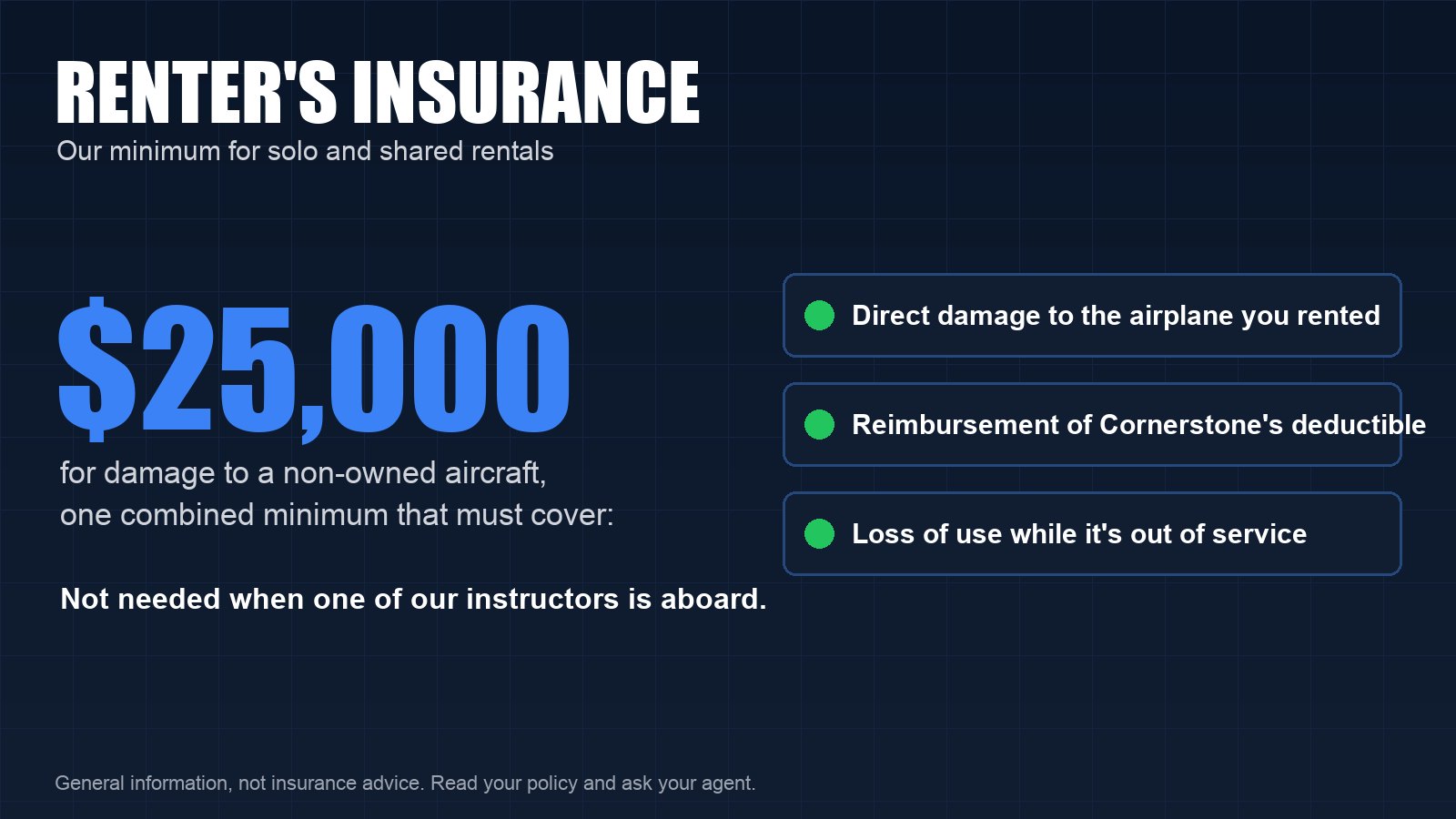
Before you fly one of our airplanes solo, or share one with another pilot, you need a current renter's policy with at least $25,000 of coverage for damage to a non-owned aircraft. That $25,000 is a single combined minimum, and the policy must be able to cover, within its terms and limits:
- Direct damage to the airplane you rented
- Reimbursement of Cornerstone's deductible
- Loss of use while the airplane is out of service
You don't need it for flights with one of our instructors aboard, such as lessons and checkouts.
We verify the coverage against your policy's declarations page. Upload a clear photo of it in the member portal or bring it to the office, and keep it current; when your policy renews, send us the new page.
Is $25,000 enough?
Our minimum is a floor. Some renters choose higher limits for damage to the aircraft, or higher liability limits, especially if they fly passengers often or fly airplanes worth more. More coverage costs more, so talk it through with your agent and pick limits you'd be comfortable relying on.
Where to get it
Several companies sell renter's policies to pilots, including the AOPA Insurance Agency and Avemco. Premiums depend on your experience, the coverage limits you choose and the insurer, so get more than one quote. Our training page estimates about $200 a year for a policy that meets our minimum, but your price may differ.
Questions to ask before you buy
- What is the limit for damage to a non-owned aircraft, and does it meet my rental operation's minimum?
- Does it cover the operator's deductible and loss of use?
- Does it cover the types of airplanes I fly, such as a Cessna 172 and a Cessna 150?
- Does it cover me as a student pilot flying solo, and does it cover instruction?
- What are the liability limits, and how are passengers covered?
- Are there exclusions I should know about, such as flights outside the United States or certain kinds of operations?
If something happens
Report any damage, incident or hard landing to us right away, before you check the airplane back in, and tell your insurer promptly; most policies require prompt notice. Write down what happened while it's fresh, and take photos if you can do so safely. Certain accidents and incidents also have to be reported to the National Transportation Safety Board under 49 CFR part 830, so if anything more than minor happens, call us first and we'll help you work out what's required.
A few things that void coverage fast
Many policies exclude flights where the pilot wasn't legal to fly: an expired medical, a lapsed flight review, flying outside your certificate's privileges, or breaking the rules the policy lists. Keep your currency up, follow your rental agreement, and fly within your limits. That's also how you avoid needing the policy in the first place.
Ready to rent?
Cornerstone Flight Academy rents a Cessna 172 and a Cessna 150 at Redlands Municipal Airport. If you have questions about our insurance requirement, or what to ask an insurer, call us before you buy a policy.
Call or text (909) 330-4748, or visit flycornerstone.com.
Book a $120 intro flight · Aircraft rental and time building · Pilot training at Cornerstone · More from the blog