Blog · Operations
Redlands Municipal Airport (KREI): A Pilot's Guide
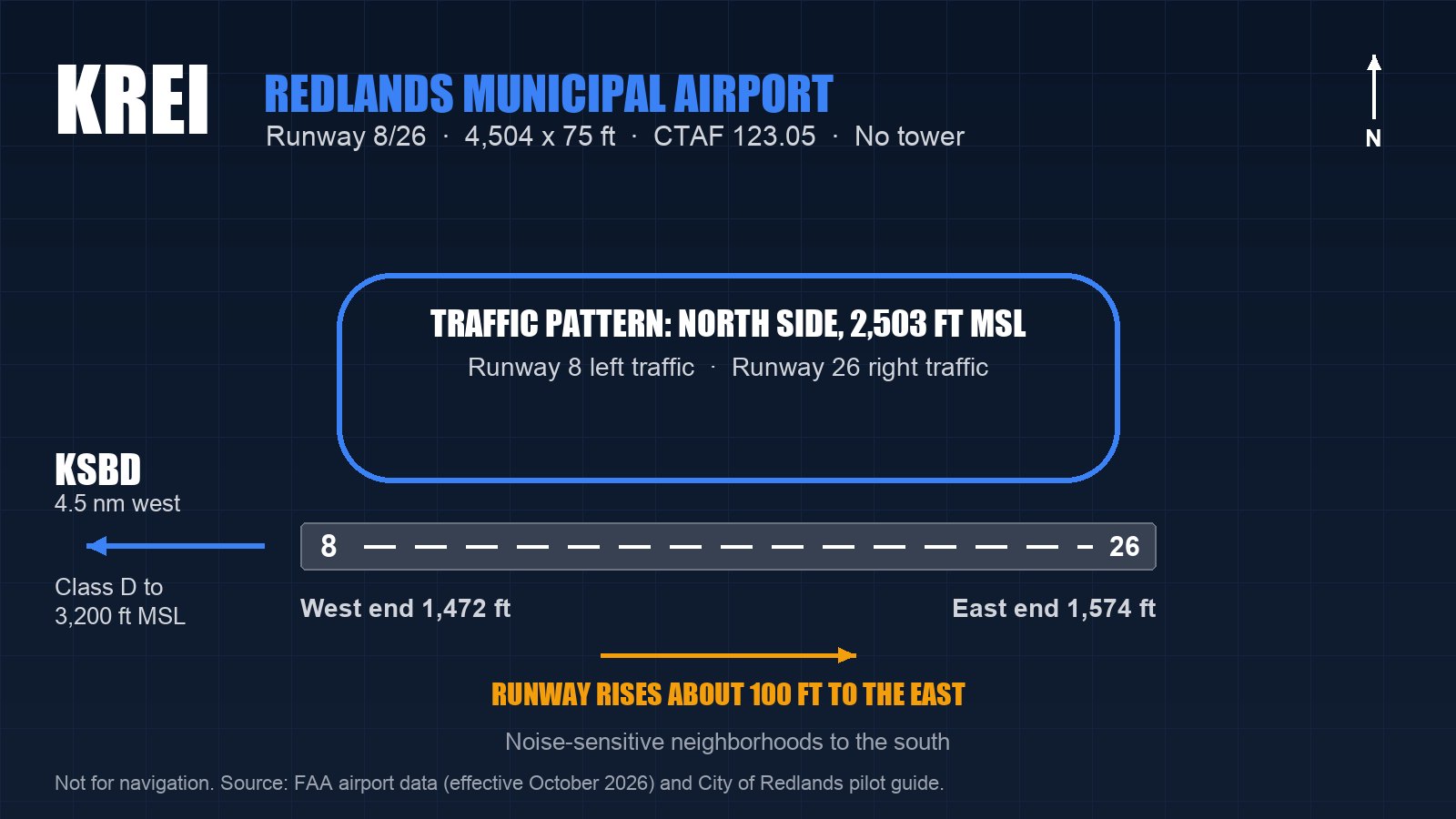
Redlands Municipal Airport (KREI) is a city-owned, non-towered airport two miles northeast of downtown Redlands, with the San Bernardino Mountains rising to the north. It's an easy airport to fly from, but it has a few habits worth knowing before your first visit: a runway that climbs about 100 feet from one end to the other, a traffic pattern that always stays north of the field, and large jets landing at San Bernardino International just to the west.
Everything below comes from the FAA's published airport data and the City of Redlands' pilot guide. Procedures change, so check the current Chart Supplement and NOTAMs before you fly. This post is not for navigation.
KREI at a glance
- Identifier: KREI (REI), field elevation 1,574 feet
- Runway 8/26: 4,504 by 75 feet, asphalt
- Traffic pattern: left traffic for Runway 8 and right traffic for Runway 26, both north of the field
- Pattern altitude: 2,503 feet MSL (929 feet above the field) for airplanes
- CTAF and UNICOM: 123.05, with pilot-controlled lighting on the same frequency
- Control tower: none
- Fuel: self-serve 100LL, available 24 hours
- Instrument approach: RNAV (GPS)-A
- SoCal Approach and Departure: 127.0
A runway that slopes
The FAA lists the west end of the runway, where Runway 8 begins, at 1,472 feet, and the east end, where Runway 26 begins, at 1,574 feet. That's about 100 feet of rise across 4,504 feet of pavement.
In practice, a Runway 8 takeoff is an uphill roll, and a Runway 26 landing touches down at the high end and rolls downhill. An upslope lengthens the takeoff roll, a downslope lengthens the landing roll, and most light-airplane performance charts assume a level runway. On a hot afternoon, when density altitude is already working against you, build in extra margin.
Which runway you use depends on the wind. The city's pilot guide suggests Runway 8 as the primary runway for night landings when the wind allows.
The pattern stays north
Runway 8 uses left traffic and Runway 26 uses right traffic, so the airplane pattern is always on the north side of the runway, at 2,503 feet MSL. The city's guide notes that the crosswind leg for Runway 26 is flown over the west end of the runway.
Helicopters fly their own pattern on the south side at 2,074 feet MSL, 500 feet above the field. If you hear a helicopter in the pattern, look south.
The city also asks pilots to avoid the noise-sensitive neighborhoods south of the airport. If you're departing Runway 26 to the west or south, its guide asks you not to fly over the homes south of the river wash below 2,200 feet MSL, as long as that's consistent with safe operation.
San Bernardino is next door
San Bernardino International (KSBD) is about four and a half nautical miles west, with a 10,000-foot runway and regular large-jet traffic. Its Class D airspace starts just west of Redlands and goes up to 3,200 feet MSL. If you're departing Runway 26 to the west or south while the tower is open, call San Bernardino Tower on 119.45 before you enter it.
The FAA's remarks for Redlands add a specific warning: watch for large and heavy aircraft within five miles of the airport, including jets on the approach to San Bernardino's Runway 24, which passes close to Redlands. Be careful of wake turbulence, monitor the Redlands CTAF and, if you can, San Bernardino on 119.45 as well, and run your transponder and ADS-B Out.
A large jet's wake sinks below its flight path, so stay at or above the jet's path and avoid crossing behind and below it.
Radios, lights and weather
- CTAF and UNICOM: 123.05. Redlands has an automated UNICOM: click your mic three times on 123.05 for automated weather and an airport advisory, or four times for a radio check.
- Lights: the runway edge lights, the runway end identifier lights at both ends and the PAPI on Runway 8 are all pilot-controlled on 123.05. The airport beacon operates from sunset to sunrise.
- Weather: the FAA's airport listing doesn't include a weather station on the field. The nearest official reports come from San Bernardino International, four miles west, whose digital ATIS is on 124.175, and Riverside Municipal (KRAL), about 17 miles southwest.
- SoCal Approach: 127.0 for approach and departure. For an IFR clearance on the ground, call SoCal clearance delivery at 1-800-448-3724.
Instrument procedures
Redlands has one instrument approach, the RNAV (GPS)-A. The letter means it has circling minimums only, with no straight-in landing minimums. The airport also has published takeoff minimums and an obstacle departure procedure for Runway 26. Review them in the current terminal procedures before an IFR departure.
Things to watch for
- Wildlife: both the FAA and the city warn of coyotes and migratory waterfowl on and near the airport.
- Aerobatics: the FAA notes aerobatic activity northeast of the airport between 3,800 and 7,800 feet MSL. Read the Chart Supplement's special notice and keep your eyes outside.
- Terrain: the San Bernardino Mountains rise steeply to the north and east. San Gorgonio Mountain, the highest peak in Southern California at more than 11,000 feet, is about 16 nautical miles east of the field.
Fuel and services
Self-serve 100LL is available around the clock from Redlands Aviation. The FAA also lists major airframe and powerplant maintenance on the field, and tiedowns for transient airplanes.
The City of Redlands publishes a one-page pilot guide for the airport with a diagram of the pattern, the noise-sensitive areas and San Bernardino's airspace. It's worth printing for your first trip.
Flying out of Redlands with Cornerstone
Cornerstone Flight Academy is based on the field at 1745 Sessums Drive, Suite 180. We rent a Cessna 172 and a Cessna 150 to checked-out pilots and train new pilots from their first lesson. If you're new to Redlands, an instructor can fly the local procedures with you before you go on your own.
Questions about flying out of KREI? Call or text (909) 330-4748, or visit flycornerstone.com.
Book a $120 intro flight · Aircraft rental and time building · Pilot training at Cornerstone · More from the blog