Blog · Training Tips
Private Pilot License Requirements: Age, Medical and Hours
Private pilot license requirements are spread across several FAA regulations, which makes them look more complicated than they are. Here they are in one place, in plain English: age, language, medical, training hours, the two tests and the paperwork. Officially it's a private pilot certificate. Most people say license, and so will we.
Who can get one
To hold a private pilot certificate for airplanes, you must be at least 17 years old and able to read, speak, write and understand English (14 CFR 61.103). You can fly solo as a student pilot at 16 (14 CFR 61.83), and you can start taking lessons before that. The dual instruction you log counts toward your certificate whenever you take it.
The medical
Before you fly solo, you need an FAA medical certificate. For most student and private pilots that's a third-class medical, issued by an aviation medical examiner (AME) after a routine exam.
How long it lasts depends on your age on the day of the exam (14 CFR 61.23). If you're under 40, a third-class medical is good through the end of the 60th month after the month of the exam. If you're 40 or older, it's good through the end of the 24th month.
Book the exam early in your training. If a medical question needs time to sort out, it's far better to find out at hour three than at hour twenty. Later on, a private pilot who has held an FAA medical certificate at any point after July 14, 2006 may be able to fly under BasicMed instead, within its limits.
The student pilot certificate
You also need a student pilot certificate before your first solo, though not before your first lesson. You apply online through the FAA's IACRA system, usually with your instructor, and the card arrives by mail in about three weeks. It doesn't expire.
Before any flight training starts, federal rules (49 CFR part 1552) also require the flight school to see proof that you're a U.S. citizen, such as a U.S. passport or birth certificate. Non-citizens need TSA approval first.
The hours: a 40-hour minimum
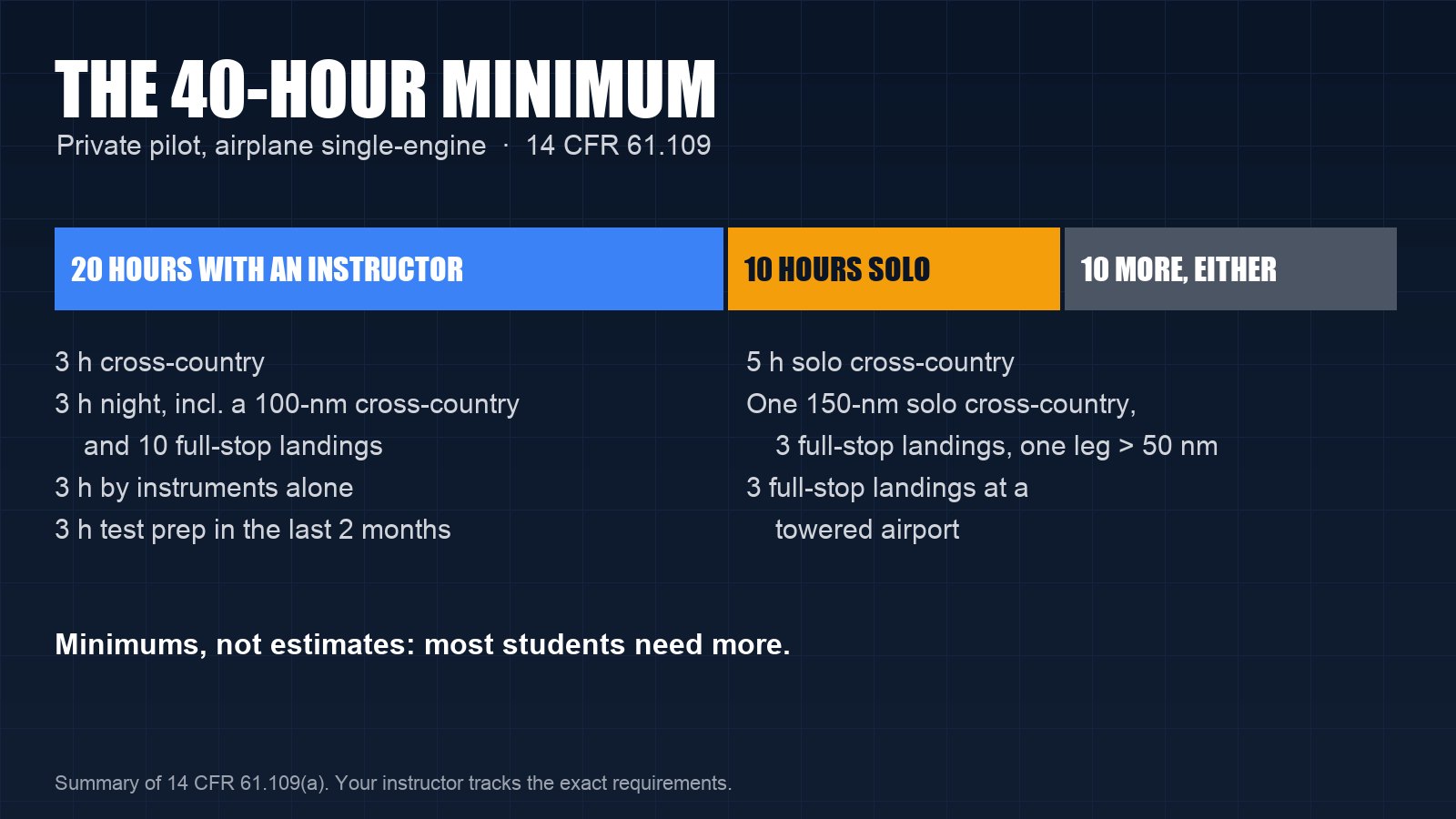
For an airplane single-engine rating, 14 CFR 61.109 sets the minimum experience at 40 hours of flight time. That has to include at least 20 hours of flight training with an instructor and 10 hours of solo flight. Within those:
- 3 hours of cross-country flight training
- 3 hours of night flight training, including one cross-country flight of more than 100 nautical miles total distance and 10 takeoffs and landings to a full stop
- 3 hours of flight training by reference to instruments alone
- 3 hours of flight training in preparation for the practical test, within the 2 calendar months before the test
- 5 hours of solo cross-country time
- One solo cross-country of at least 150 nautical miles total distance, with full-stop landings at three points and one leg of more than 50 nautical miles
- 3 solo takeoffs and landings to a full stop at an airport with an operating control tower
Forty hours is a floor, not an estimate. Most people need more, and how many more depends mostly on how often you fly. Two or three lessons a week keeps skills from fading between flights; once a week usually means some of every lesson goes to catching up.
Redlands makes the specific items easy to plan. San Bernardino International, about four nautical miles west, has a control tower, and Riverside and Chino are each within about 25 nautical miles. For the long solo cross-country, Thermal, Oceanside and Carlsbad are all more than 50 nautical miles from Redlands.
The two tests
The knowledge test. Once your instructor endorses you as prepared, you take the FAA's private pilot knowledge test at an approved testing center: 60 multiple-choice questions, two and a half hours, and 70 percent to pass. Your result is good for 24 calendar months, and you need to pass the practical test within that window (14 CFR 61.39).
The practical test. Better known as the checkride, it's given by an FAA examiner, usually a designated pilot examiner. It has an oral portion on the ground and a flight portion, both graded against the FAA's Airman Certification Standards for private pilots. Your instructor has to endorse you for it, and you need to have met all of the experience requirements above before you apply.
What the certificate lets you do
As a private pilot, you can act as pilot in command of a single-engine airplane, carry passengers, and fly day or night under visual flight rules. You can share the cost of a flight with your passengers, as long as you pay at least your share of the fuel, oil, airport fees or rental (14 CFR 61.113). You can't fly for compensation or hire; that takes a commercial certificate. Flying in clouds takes an instrument rating.
A realistic order of events
- Take a first lesson to see if you like it.
- Get your FAA medical early.
- Apply for your student pilot certificate a few weeks before you expect to solo.
- Pass the pre-solo knowledge test your instructor gives you, and solo.
- Fly your solo cross-countries and the night, instrument and towered-airport requirements.
- Pass the knowledge test.
- Polish everything to the Airman Certification Standards, and take the checkride.
Training in Redlands
Cornerstone Flight Academy trains private pilots under Part 61 at Redlands Municipal Airport (KREI), with a dedicated instructor and an IFR-equipped Cessna. You can see how our training works on our training page.
Questions about getting started? Call or text (909) 330-4748, or visit flycornerstone.com.
Book a $120 intro flight · Aircraft rental and time building · Pilot training at Cornerstone · More from the blog