Blog · Aircraft Update
Inside N5424T: A Cessna 172 With Dual G5s and a WAAS GPS
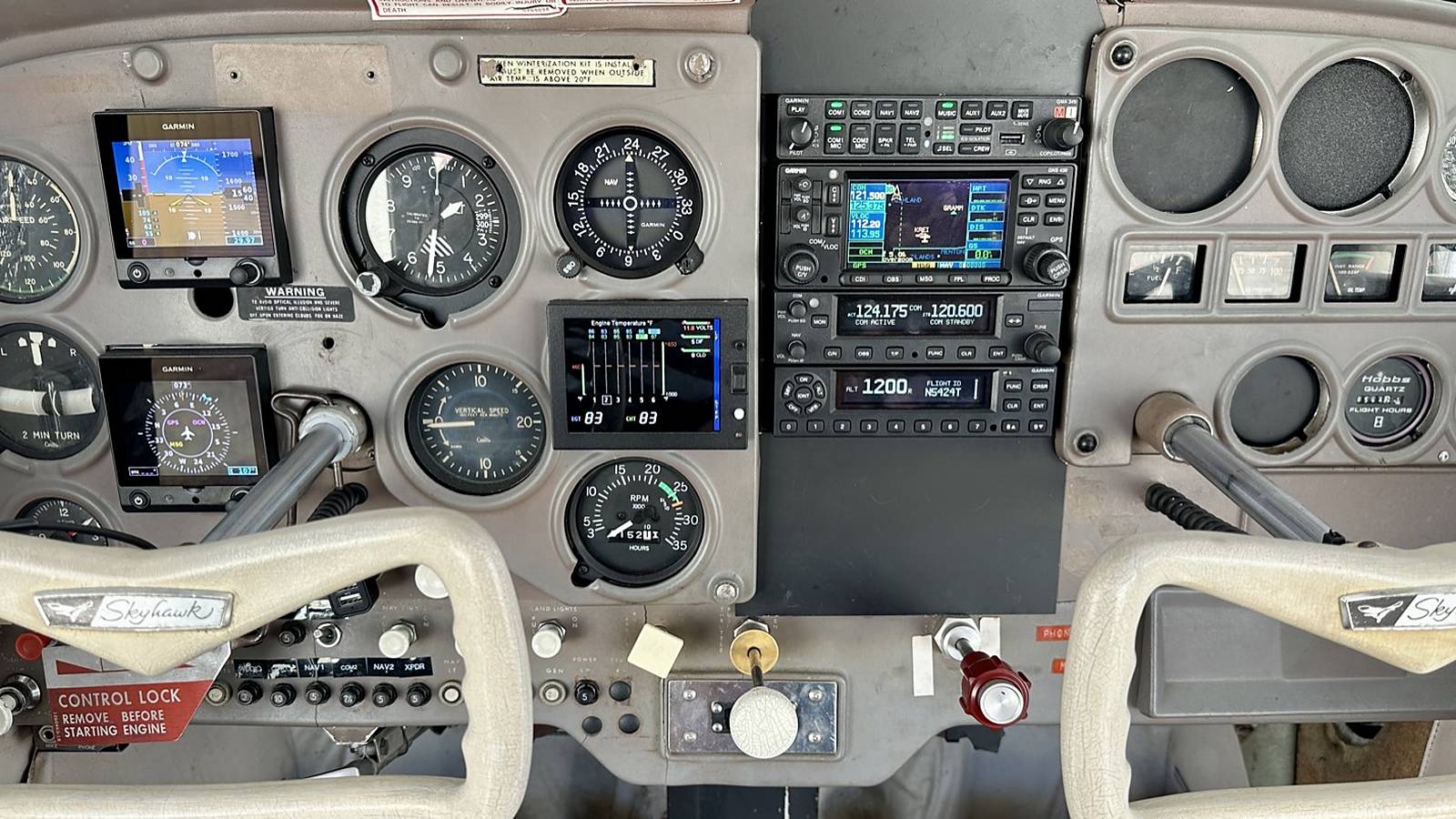
N5424T is the Cessna 172 in our fleet, and its panel is a big part of why pilots choose it. It's an older airframe, a Cessna 172E, with a modern set of avionics that makes it a strong airplane for private pilot training, instrument training and cross-country flying. Here's a tour of the panel, and what each piece does for you.
Two Garmin G5 electronic flight instruments
The G5 is a compact digital flight instrument with a bright display. N5424T has two of them, which display core flight information such as attitude, airspeed, altitude and heading on clear, easy-to-read screens. For a student, that can mean less hunting around the panel for the basics. For an instrument pilot, a clean, stable display helps you fly precisely when you can't see outside.
Garmin GNS 430W: WAAS GPS, nav and com
The GNS 430W combines a GPS navigator, a VHF communication radio and a VHF navigation receiver for VOR, localizer and glideslope signals. The W means it uses WAAS, the satellite-based augmentation system that makes GPS accurate enough for approaches with vertical guidance. Where they're published, that lets you fly RNAV (GPS) approaches down to LPV minimums, which can be close to ILS minimums.
A Garmin GI 106 course deviation indicator rounds out the navigation displays.
Garmin GNC 255: a second nav/com
The GNC 255 is a second VHF communication radio with its own navigation receiver. Two nav receivers let you track a VOR on one while you use the other for something else, which is exactly what instrument training and real-world IFR flying ask of you. A second com radio lets you listen to the weather or talk to ground while the first stays on the tower or approach frequency.
Garmin GMA 345 audio panel
The audio panel ties the radios and the intercom together, and the GMA 345 adds Bluetooth, so you can connect a phone or tablet to the audio system.
Garmin GTX 330ES transponder
The GTX 330ES is a Mode S transponder with extended squitter, which provides ADS-B Out. ADS-B Out is required in most of the busier airspace around Southern California, including Class B and Class C airspace and above 10,000 feet MSL, so it keeps those options open.
Where ADS-B Out matters
Under 14 CFR 91.225, ADS-B Out is required in Class B and Class C airspace, above the ceiling of Class B or C airspace up to 10,000 feet, within 30 nautical miles of the country's busiest airports, and in Class E airspace at and above 10,000 feet MSL outside the lowest 2,500 feet above the ground. Around Southern California, that covers a lot of the airspace you'll want: Ontario and March are Class C, and Los Angeles and San Diego are Class B. With the GTX 330ES, none of it is off limits for equipment reasons.
JPI EDM 730 engine monitor
The EDM 730 shows exhaust gas and cylinder head temperatures for every cylinder, along with other engine data. It makes leaning the mixture accurate rather than approximate, helps you spot a problem cylinder early, and teaches you a lot about how an engine behaves. On a dry rental, good leaning also saves you fuel. N5424T burns about 6 to 7 gallons an hour at economy cruise.
Read the supplements before you fly
Each piece of installed avionics comes with its own supplement to the airplane's flight manual, covering how it's installed, its limitations and its operating procedures. Read the ones for the 430W, the G5s and the transponder before your first flight in N5424T, and keep the pilot's guides handy. Knowing how the equipment is supposed to work is the first step to noticing when it doesn't.
Good for keeping current, too
If you already hold an instrument rating, the same panel makes N5424T a good airplane for staying current and for an instrument proficiency check: real approaches with a WAAS GPS, a second nav receiver for VOR and localizer work, and displays that make partial-panel and unusual-attitude practice realistic with an instructor.
Why the panel matters for training
- Private pilot training: you learn on a clean, modern panel, and the same airplane carries you straight into instrument training.
- Instrument training: WAAS GPS approaches, two nav receivers for VOR and ILS work, and a second com cover what the instrument rating asks of you.
- Cross-country flying: GPS navigation, ADS-B Out and an engine monitor make longer trips easier and better informed.
Equipment only helps if you know how to use it. If you're new to the 430W or the G5s, an instructor can spend time on them during your checkout or a lesson.
Fly it
Cornerstone Flight Academy rents N5424T at Redlands Municipal Airport for training, time building and cross-country trips, alongside our Cessna 150. Current rates are on our website.
Call or text (909) 330-4748, or visit flycornerstone.com.
Book a $120 intro flight · Aircraft rental and time building · Pilot training at Cornerstone · More from the blog