Blog · Instrument Flying
IFR Currency vs. IFR Proficiency: What Southern California Pilots Get Wrong
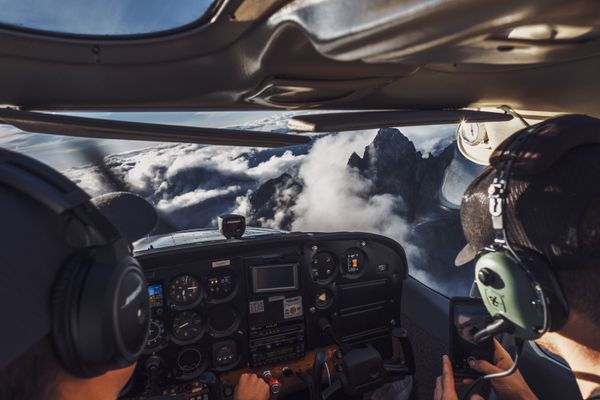
There's a distinction in instrument flying that doesn't get enough attention: the difference between being current and being proficient. They are not the same thing, and confusing them is one of the most common — and dangerous — mistakes instrument-rated pilots make.
What Currency Means
IFR currency is a legal standard defined by FAR 61.57(c). To act as PIC under IFR, a pilot must have logged within the preceding 6 calendar months:
- 6 instrument approaches
- Holding procedures and tasks
- Intercepting and tracking courses through the use of navigational electronic systems
If you don't meet these requirements, you are not instrument current and cannot legally fly as PIC under IFR or in IMC. For the next six calendar months you can get current again by flying those tasks in simulated instrument conditions with a safety pilot or an instructor, or in an approved simulator or training device. Once you've been out of currency for more than six calendar months, the only way back is an Instrument Proficiency Check (IPC) with an instructor or examiner (FAR 61.57(d)).
That's the legal definition. Here's the problem: meeting the legal standard is a very low bar.
What Proficiency Actually Means
Proficiency is the operational standard — the level of skill required to safely fly an instrument approach to minimums, handle a missed approach, manage an unexpected system failure, and make sound aeronautical decisions in IMC.
Currency tells you whether you've been logging approaches. Proficiency tells you whether you can actually execute them safely under pressure.
A pilot can be technically current — 6 approaches in 6 months — and genuinely not proficient. Six RNAV approaches at a single airport, flown under a view-limiting device on clear days, plus holding and course tracking, satisfies the FAA requirement. It does not prepare you for a real-world ILS to minimums at an unfamiliar airport in actual IMC with a tailwind on the missed.
Why This Matters More in Southern California
SoCal's weather pattern creates a specific trap for instrument pilots: most of the year is clear and sunny. That means:
1. Actual IMC is infrequent. Most SoCal IFR flying happens in VMC under IFR flight plans — which builds currency but not the habit of actual instrument scan under real task saturation.
2. Marine layer creates sudden IMC. The coastal marine layer can move inland faster than pilots expect, particularly in summer months. A pilot who hasn't flown in actual IMC recently may be current but underprepared when it matters.
3. Mountain and desert IFR has unique hazards. Icing in the San Bernardinos, turbulence through the passes, and complex approach procedures at high-elevation airports require genuine proficiency — not just recent approaches.
4. Long gaps between actual IMC create skill erosion. If your IFR flying is primarily VFR-on-top and clear approaches, your scan deteriorates. When you actually need the skills — in the soup, with a partial panel, on a short approach — they may not be there.
How to Stay Genuinely Proficient
Fly actual IMC when it's appropriate and within your minimums. The marine layer that socks in coastal airports is a training opportunity if you're properly equipped, current, and flying with a CFII. Don't always divert around IMC — use it as the training environment it is, with appropriate safety margins.
Vary your approach types. If all your recent approaches are RNAV GPS, make sure you're also flying ILS, VOR, and localizer approaches. Different approach types have different scan requirements and failure modes.
Fly to unfamiliar airports. A new airport's approach plate, unfamiliar terrain, and different ATC procedures add genuine workload — which is closer to real-world conditions than the same approach at your home field.
Fly partial panel. Cover the attitude indicator and directional gyro occasionally during training. Partial panel work is a required IPC element for a reason — vacuum system failures are real, and the scan required is significantly different.
Get an IPC more frequently than required. The IPC requirement only kicks in after you've been out of currency for more than six calendar months. Consider treating it as a regular proficiency check every 6 months regardless — the structured review with a CFII is one of the best ways to find skill gaps before they matter.
Use the simulator. An FAA-approved training device such as an AATD or BATD can be used for all of the instrument currency tasks in FAR 61.57(c), in any combination with flying the airplane, and is an efficient way to practice partial panel, unusual attitudes, and approach procedures without weather dependency.
The IPC: What It Covers
An Instrument Proficiency Check can be given by an instrument instructor (CFII) or an examiner, and it must cover the tasks the Instrument Rating ACS lists for an IPC. In a single-engine airplane, those are:
- Holding procedures
- Recovery from unusual flight attitudes
- Intercepting and tracking navigational systems and DME arcs
- A nonprecision approach and a precision approach
- A missed approach
- A circling approach
- Landing from an instrument approach
- An approach with loss of primary flight instrument indicators (partial panel)
- Checking instruments and equipment after the flight
A thorough IPC exposes where your proficiency has drifted — which is exactly the point. Think of it as a reset, not a test.
The Bottom Line
Being current means you're legal. Being proficient means you're safe. In Southern California's weather environment, the gap between those two things is often wider than pilots realize.
Before your next IFR flight — especially if it's been more than 60 days since you flew in actual IMC — ask yourself honestly: if I broke out at minimums on this approach with a crosswind and needed to execute a missed, am I genuinely ready for that?
If the answer isn't a clear yes, schedule time with a CFII before you file.
Cornerstone Flight Academy offers IPCs and instrument currency training with an instrument instructor (CFII). Contact us or check availability here.
Cornerstone Flight Academy offers flight training and aircraft rental at Redlands Municipal Airport (KREI), for student pilots and for certificated pilots building time and ratings.
Book a $120 intro flight · Aircraft rental and time building · Pilot training at Cornerstone · More from the blog