Blog · Operations
Dry vs. Wet Aircraft Rental Rates: How to Compare
When you shop for an airplane to rent, the first thing that trips people up is dry vs. wet pricing. One operator quotes one hourly number, another quotes a different one, and they aren't measuring the same thing. Here's how to compare them fairly, so you know what an hour of flying will actually cost.
What the words mean
A wet rate includes fuel. You pay one hourly number, and the operator buys the fuel.
A dry rate doesn't include fuel. You pay for the airplane by the hour and pay for fuel separately, according to the operator's fuel policy.
Neither is better by definition. A wet rate is simple. A dry rate is transparent: you pay for the fuel you actually burn, at the price you actually pay, and a pilot who leans carefully and flies efficiently isn't subsidizing one who doesn't.
Convert a dry rate to a wet one
The math is simple:
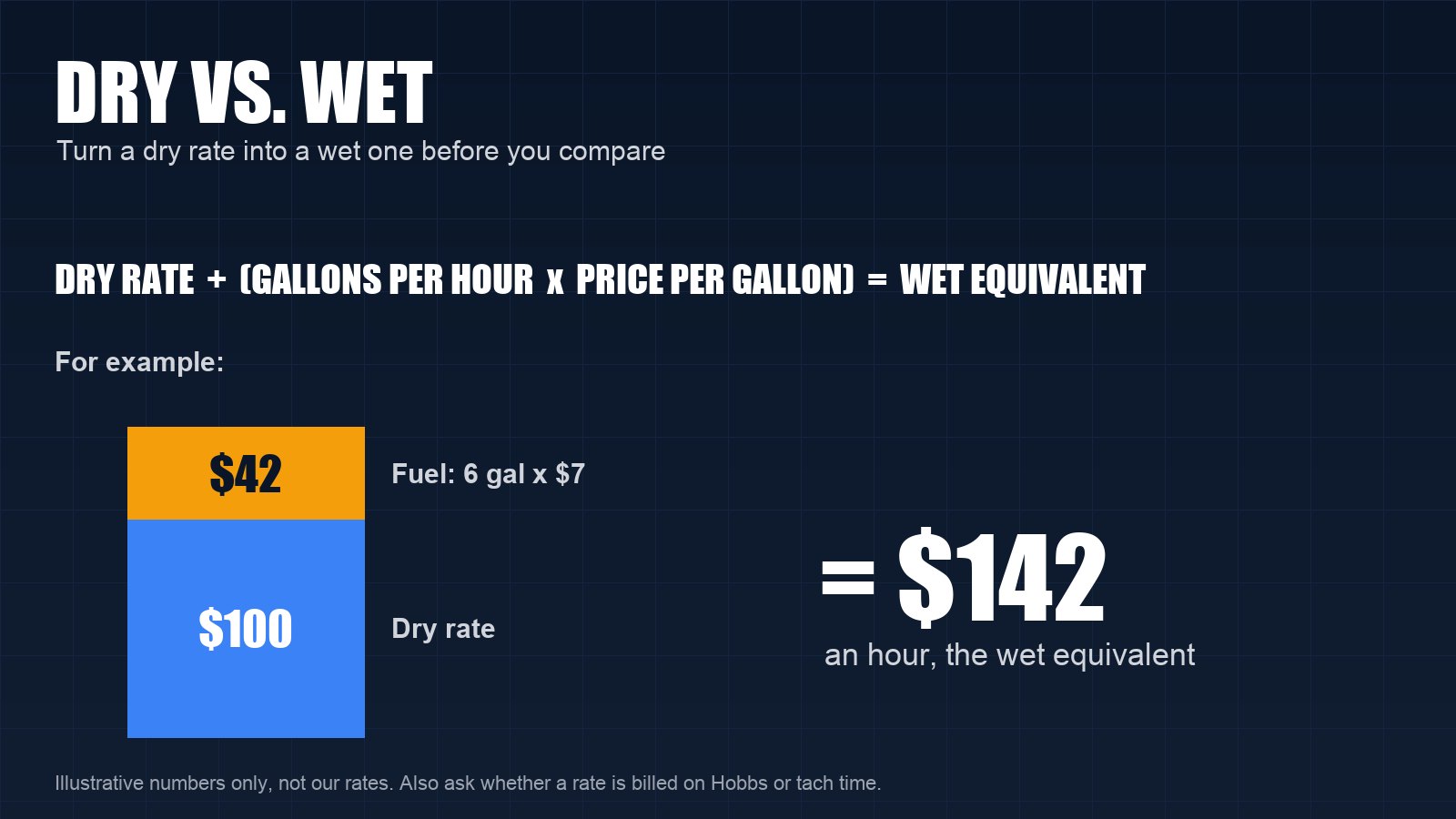
Dry rate + (fuel burn per hour x fuel price per gallon) = the equivalent wet rate
Say an airplane rents for $100 an hour dry, burns 6 gallons an hour, and fuel costs $6.50 a gallon. That's 100 + (6 x 6.50), or $139 an hour, wet. Compare that number, not the $100, with a wet quote.
A few details make the estimate honest:
- Use realistic fuel burn. The cruise figure in the handbook assumes a particular power setting and a properly leaned mixture. Taxi, run-up and climb burn more, so the average over a whole flight is usually a little higher than cruise.
- Use the price you'll pay. Fuel prices vary from airport to airport, and self-serve fuel is often cheaper than full service. Redlands has self-serve 100LL available around the clock.
- Run it for the airplane you'll fly. A Cessna 150 and a Cessna 172 burn noticeably different amounts, and that difference is part of the real price gap between them.
On a dry rental, leaning pays you back
With a dry rate, the fuel you save is money you keep. Leaning the mixture in cruise as your airplane's handbook describes can make a real difference over a year of flying, and an engine monitor makes it easier to lean accurately. Both of our airplanes have one: a JPI EDM 730 in the Cessna 172 and a JPI EDM 700 in the Cessna 150.
The same math explains why the smaller airplane builds hours more cheaply. Our 150 burns about 4.5 to 5 gallons an hour at economy cruise and our 172 about 6 to 7. At $6.50 a gallon, that 1.5 to 2 gallon difference is worth about $10 to $13 an hour before you even compare the rental rates.
Wet rates aren't always fixed
Some wet rates include a fuel surcharge that moves with fuel prices, and some operators reimburse fuel you buy away from home at a set price per gallon. If you're comparing a wet rate, ask whether it changes when fuel does, and how fuel bought elsewhere is handled.
Hobbs time vs. tach time
The other half of the comparison is what counts as an hour.
- Hobbs time is clock time, recorded by a meter that runs while the engine runs.
- Tach time is tied to engine RPM. At the lower RPM most airplanes use in cruise, the tachometer usually records less than one hour for each hour of flying.
That means an hourly rate billed on tach time and one billed on Hobbs time aren't directly comparable either. Ask which meter each rate uses before you compare them. Cornerstone's rental rates are dry, billed on Hobbs time.
Ask about everything else
The hourly rate is only part of what you'll pay. Before you choose, ask about:
- Membership or club fees, monthly or annual
- Block rates and how much you have to buy to get them
- Instruction, including who sets the instructor's rate and how it's billed
- Checkout costs for each airplane
- Insurance requirements for renters
- Fuel policy, including what happens when you buy fuel away from home
- Cancellation, late return and overnight policies
- Availability. A good rate on an airplane you can't book isn't a good rate.
Put it in one table
The fairest comparison puts every option on the same footing. For each airplane, write down the rate, whether it's wet or dry, which meter it uses, the realistic fuel burn and fuel price, and any fees spread over the hours you expect to fly in a year. Then compare the cost of an actual hour in the air.
Renting dry at Redlands
Cornerstone Flight Academy rents a Cessna 172 and a Cessna 150 dry at Redlands Municipal Airport, by the hour or in blocks, with a flat annual fee and no monthly dues. Our current rates are on our website.
Questions about what your flying would cost? Call or text (909) 330-4748, or visit flycornerstone.com.
Book a $120 intro flight · Aircraft rental and time building · Pilot training at Cornerstone · More from the blog