Blog · Aircraft Update
Cessna 150 vs. Cessna 172: Which Should You Rent?
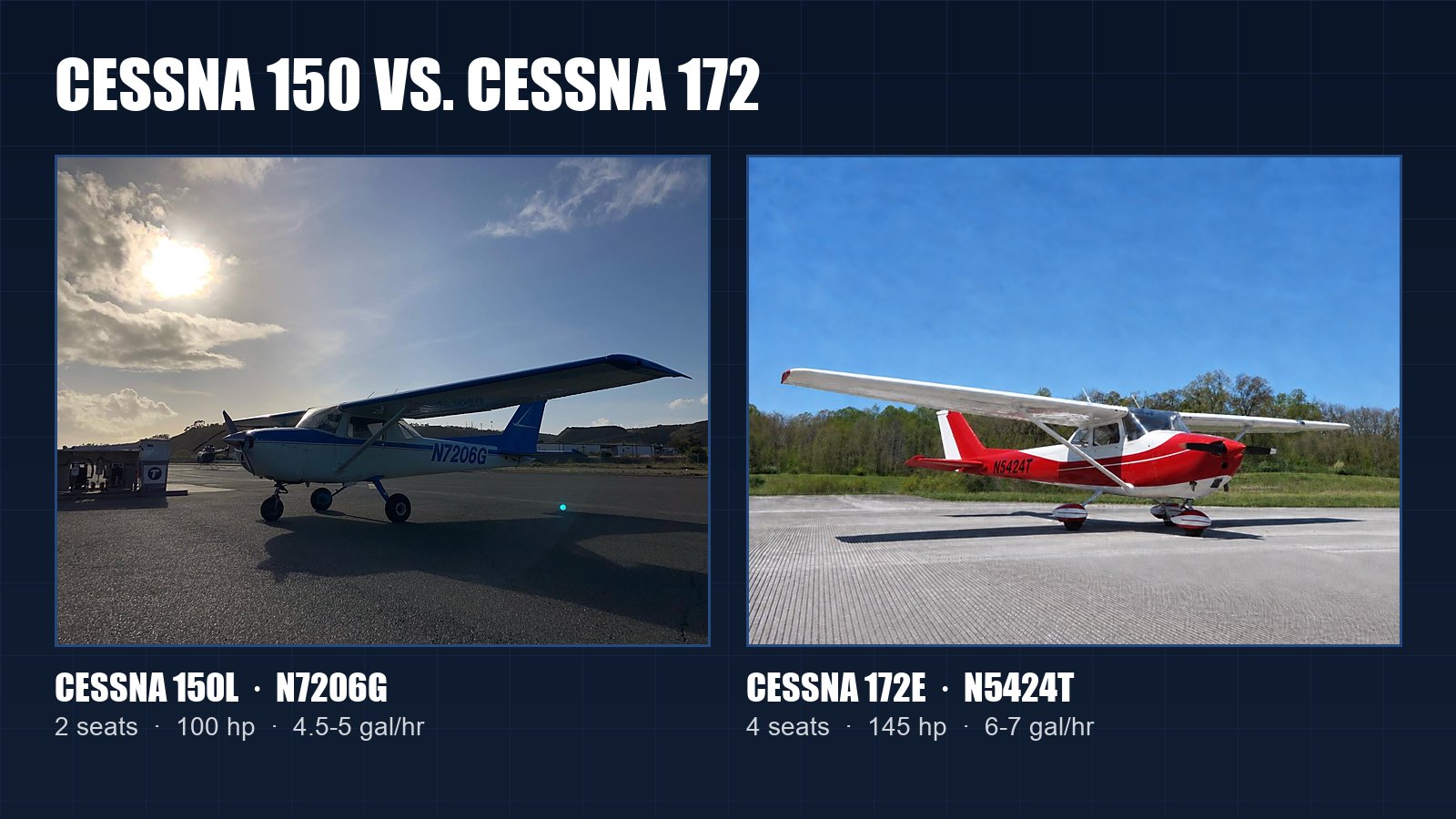
Cessna 150 vs. Cessna 172 is one of the most common questions renters ask, and there's no single right answer. They're the two airplanes we fly at Cornerstone, N7206G and N5424T, and each one is the better choice for different flights. Here's how they compare.
The basics
Cessna 150L, N7206G
- Two seats
- Continental O-200 engine, 100 horsepower
- About 4.5 to 5 gallons an hour at economy cruise
- IFR-equipped
Cessna 172E, N5424T
- Four seats
- Continental O-300 engine, 145 horsepower
- About 6 to 7 gallons an hour at economy cruise
- IFR-equipped
Both are high-wing Cessnas with carbureted engines and the same basic handling, so the skills you build in one carry straight over to the other.
Where the Cessna 150 shines
- Cost. The 150 rents for less per hour and burns about 1.5 to 2 gallons an hour less fuel, which adds up quickly over a block of time-building hours.
- Solo time building. For hours in the pattern, practice-area work and solo cross-countries, it does everything you need for less.
- Stick-and-rudder feel. It's light, responsive and honest, which makes it a good airplane for sharpening basic skills.
The trade-offs are room and load. Two adults, full fuel and baggage can bring a 150 close to its maximum weight, so run the weight and balance for every flight, not just the ones that feel heavy. On hot days at higher-elevation airports, its 100 horsepower makes density altitude more noticeable.
Where the Cessna 172 shines
- Seats and load. Four seats and more useful load mean you can bring an instructor and a bag, or a couple of passengers.
- Performance. With 145 horsepower, it climbs better and cruises faster, which helps on longer cross-countries, in summer heat, and at high-desert airports.
- Avionics. N5424T has two Garmin G5 electronic flight instruments, a WAAS-capable Garmin GNS 430W GPS, a second nav/com, a Garmin audio panel, a Garmin GTX 330ES transponder and a JPI EDM 730 engine monitor.
- Training. It's the airplane we use for private pilot training, and the WAAS GPS makes it the better choice for instrument training, because it can fly GPS approaches down to LPV minimums where they're published.
The time-building math
Fuel is where the difference shows up beyond the rental rate. At $6.50 a gallon, the 150's lower burn saves roughly $10 to $13 for every hour you fly it instead of the 172. Over a 25-hour block of time building, that's around $245 to $325 in fuel alone, before you compare the hourly rates. Run the numbers with the current fuel price at the pump.
How they fly
Both are forgiving, conventional high-wing trainers, and the skills transfer directly. The 150 is lighter on the controls and feels its size; the 172 feels more solid, especially in turbulence, and its extra power gives you more margin in a climb. Pilots who learned in one usually feel at home in the other after a single checkout flight.
Panels compared
N7206G, the 150, has a Garmin 430 GPS, a King KX 155 nav/com, a Garmin audio panel and a JPI EDM 700 engine monitor, and it's equipped for instrument flight.
N5424T, the 172, adds the G5 displays and the WAAS-capable 430W. If your goal is an instrument rating, or you want the panel you'll keep using after training, the 172 is the one to learn.
Which should you rent?
- Building solo hours as cheaply as possible: the 150.
- Training for your private pilot certificate: the 172, our primary trainer.
- Instrument training or IFR practice: the 172, for the WAAS GPS.
- A trip with a passenger and bags, or a hot afternoon at a high airport: the 172.
- Pattern work, practice-area maneuvers and short hops on your own: the 150.
Plenty of pilots get checked out in both and choose by the flight. That's often the most economical way to fly.
Questions to ask before each flight
- Who's coming? One light passenger and no bags can work in the 150; two or more people means the 172.
- How far, and how high? Longer legs, high-desert airports and hot afternoons favor the 172's power.
- What are you practicing? Instrument work favors the 172's panel; landings and maneuvers work well in either.
- What's your budget for the month? The 150 stretches it further.
Getting checked out
Each airplane needs its own checkout with one of our instructors. It's worth doing both: the 150 for economy and the 172 for capability.
Cornerstone Flight Academy rents both at Redlands Municipal Airport, by the hour or in blocks. Current rates are on our website.
Questions about which one fits your flying? Call or text (909) 330-4748, or visit flycornerstone.com.
Book a $120 intro flight · Aircraft rental and time building · Pilot training at Cornerstone · More from the blog